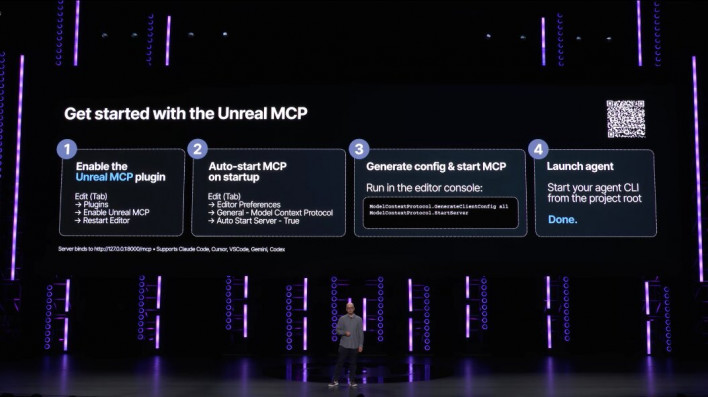
Epic has put an AI-coding doorway inside Unreal Editor for Fortnite. The new Unreal MCP beta lets compatible coding agents work with a creator's UEFN project: they can write and compile Verse, place devices, change settings and run a play session.
That is a big deal if you have ever opened UEFN with a decent island idea and then hit the part where the editor stops speaking English. Want fireworks at a finish line? An agent can set up the trigger. Want a game rule to begin when a round starts? It can draft the Verse and see whether it compiles.
The promise is not that Fortnite has found a button marked “make my game.” It is that the awkward first hour gets shorter.
What Epic has actually added
Unreal MCP is a Model Context Protocol server built into UEFN. It connects an agentic coding tool to the editor running on the creator's own machine. Epic says the available tools can read, write and compile Verse files; browse and configure UEFN devices; make Scene Graph changes; build UMG interface elements; and start or inspect play sessions.
The useful detail is that the agent does not produce a sealed-off result. Its changes land in the normal project. The Verse file is still there. The device can still be selected in the Details panel. The new entity is still in the outliner. A creator can take over, change it or delete it.
That makes the beta more interesting than a text-to-game demo. It is an assistant inside the existing workshop, with access to the fiddly jobs that often stop a small idea becoming a playable prototype.
The argument follows the tool into Fortnite
Coding agents are having a moment because they can make a blank project feel less blank. They can explain an unfamiliar file, sketch a mechanic, fix a simple compile error and handle repetitive setup without asking a creator to memorise every menu.
Their critics are not usually arguing that this is useless. The concern is that generated code can look finished before it has been understood. A working test is not the same as a good game. An agent may produce a neat-looking system that clashes with the rest of an island, creates a miserable balance problem or fails in the odd situation nobody thought to test.
That is the trade-off UEFN creators will have to manage. The agent lowers the barrier to starting, but it does not lower the need for judgment. If a creator cannot explain what a device is doing, they will have a hard time fixing it when a player finds the one path through the map that breaks everything.
There is evidence for both sides of the argument. Google's 2025 DORA research found that 59% of surveyed technology professionals said AI had improved code quality. That is a measure of what people report, not a universal verdict on the tools. A separate randomised study by METR put early-2025 AI tools in the hands of experienced open-source developers working on repositories they already knew and found that, in that setting, tasks took 19% longer on average. The study is not about Fortnite, and the tools have moved quickly since then. It is still a useful warning against treating a confident-looking output as free speed.
The disagreement is less mysterious than it first sounds. Agents can be very good at getting someone from no prototype to a prototype. They can be less reliable when the work depends on all the quiet context inside a long-running project: conventions, old workarounds, player expectations and the reason a strange-looking bit of code exists in the first place.
A better use than “build it for me”
For a new UEFN creator, the strongest use may be conversational tutoring with a practical result. Ask an agent to add a simple mechanic, then open the resulting Verse file and make it explain each part. Start a test session. Break the mechanic on purpose. Change one value and see what happens.
That is slower than blindly accepting a pile of changes, but it leaves the creator with an island they can keep maintaining. It also makes the beta useful to people who are not trying to become full-time programmers. A level designer can get a rough interaction working, then spend their time on the things an agent cannot settle for them: whether the map is fun, whether a rule feels fair and whether players will understand what they are meant to do.
Epic says Unreal MCP is still in beta, and not every Unreal Engine 5.8 toolset works in UEFN yet. Creators should expect rough edges, review every change and treat the playtest as part of the feature—not the final box an agent ticks after the work is done.
Fortnite's creator scene has always been crowded with people who can imagine a game before they can build one. This release may give more of them a way over that first technical wall. The harder question begins after they get there: whether they use the extra speed to learn the tools, or to ship something they cannot repair.



No comments yet. Be the first to add something useful.